
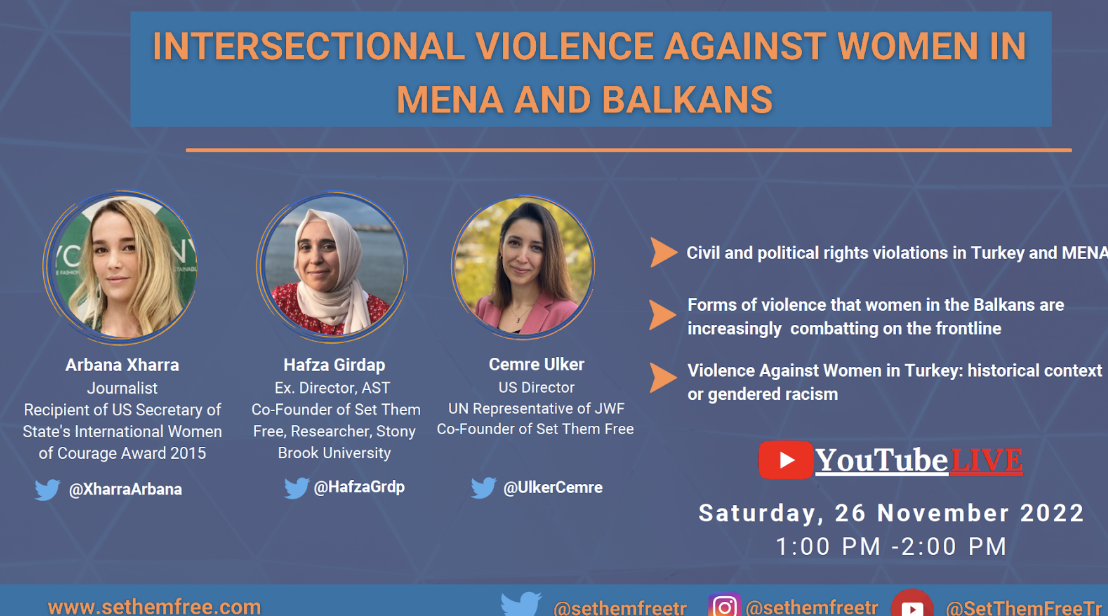
Intersectional Violence Against Women in MENA and Balkans
26 November 2022 | 1:00 PM | YouTube
This event was a comprehensive and urgent discussion on intersectional violence against women in the Middle East and Balkans, marking the launch of the Orange the World Campaign 2022, part of the UN Women’s 16 Days of Activism Against Gender-Based Violence. The panel featured human rights advocate Cemre Ulker, journalist Arbana Xharra, and activist, academic Hafsa Girdap, who collectively addressed the complexities of gender violence, political repression, and the influence of authoritarian regimes in these regions.
The event opened with welcoming remarks, emphasizing the alarming rise of patriarchal and oppressive regimes globally, which place women on the front lines of combating state-led violence and systemic violations across civil, political, economic, and social spheres. Cemre Ulker underscored that peace must go beyond the absence of conflict; it requires systems that enable women from diverse backgrounds to participate fully in decision-making processes. She highlighted how women are often stereotyped solely as victims, which undermines their leadership potential and hinders empowerment efforts.
The discussion then focused on the specific situation in Turkey, where speakers detailed the backsliding of democracy and the severe human rights violations against women, journalists, and political prisoners. Experts cited recent arrests of Kurdish women, the closure of women’s rights organizations like the We Will Stop Femicide Observatory. The repression extends to legal impediments, violence, and censorship, with the current regime`s influence spreading into the Balkans through political, religious, and economic investments, further complicating regional stability and women’s rights.
Arbana Xharra provided insights into the Balkan context, highlighting Turkey`s expanding influence in countries like Kosovo, Bosnia, and Serbia. She explained how authoritarian regimes leverages religious institutions and economic interests to consolidate power, while journalists and civil society face threats, harassment, and imprisonment for speaking against his agenda. Xharra emphasized the lack of international media coverage about Turkey’s human rights violations, noting the critical need for raising awareness and fostering solidarity.
Hafsa Girdap elaborated on gender-based violence (GBV) as a political issue intertwined with patriarchy, authoritarianism, and religious fundamentalism. She defined GBV as threats and harm rooted in gender identity, manifesting in various forms such as physical, sexual, psychological, and institutional violence. Girdap pointed out how regimes like Iran, Afghanistan, and Turkey impose oppressive laws—such as mandatory hijab and restrictions on women’s autonomy—while far-right movements in the West also reinforce Islamophobic narratives that justify discrimination and violence against Muslim women. She stressed that gender-based violence is not merely personal but deeply political, requiring education, awareness, and political action at all levels.
The panelists discussed the global solidarity demonstrated by women protesting in Iran, where courageous women are risking their lives to oppose oppressive regimes. They emphasized that international responses remain insufficient without concrete political pressure, sanctions, and diplomatic engagement. The importance of sustained education, awareness campaigns, and consistent political will was repeatedly highlighted as essential for long-term change.
The conversation concluded with a call for greater activism, media coverage, and political action. Panelists urged governments, international organizations, and civil society to challenge regimes that violate women’s rights through sanctions and diplomatic pressure. They also emphasized the role of education in empowering communities and ensuring that perpetrators of violence are held accountable.
This virtual discussion underscored the critical need for global solidarity, political will, and strategic activism to combat intersectional violence against women, promote gender equality, and uphold human rights in regions plagued by authoritarianism and conflict. The panelists expressed hope that increased awareness and concerted action by the international community could lead to meaningful progress in safeguarding women’s rights worldwide.
PANELISTS:
Hafza Girdap, Executive Director of Advocates of Silenced Turkey, Co-Founder of Set Them Free – USA
Arbana Xharra, Journalist, Recipient of US Secretary of State`s International Women of Courage Award 2025
Cemre Ulker, Representative of the JWF to the UN, Co-Founder of Set Them Free
 Previous Post
 Next Post