
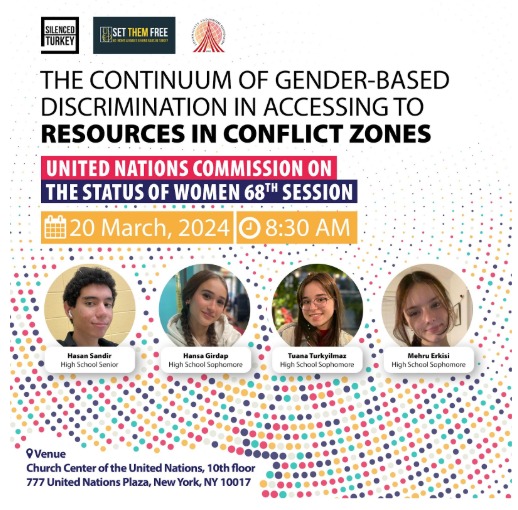
The Continuum of Gender-Based Discrimination in Accessing to Resources in Conflict Zones
On the Occasion of the UN Commission on the Status of Women 68th Session 20 March 2024 | 8:30 AM | Church Center for the UN
This UN Commission on the Status of Women panel discussion convened by youth advocates presented a comprehensive discussion on gender-based oppression, discrimination, and violence across various global contexts, primarily focusing on Turkey, Afghanistan, and the Democratic Republic of the Congo (DRC). The speakers, including students and activists, highlighted the systemic nature of gender-based violence, emphasizing that it is not merely an individual issue but deeply rooted in political, cultural, and social structures. They illustrated how state institutions and societal norms perpetuate discrimination against women and marginalized genders, often using violence as a means to control and silence the opposition views.
Covering Turkey, the speakers discuss the rise in authoritarianism under the ruling party, which has led to significant backsliding in democracy and civil liberties, particularly affecting women’s rights. Personal narratives shed light on the impact of child marriage, domestic violence, and the alarming rates of femicide. In Afghanistan, the Taliban’s oppressive regime is described as systematically erasing women’s rights and freedoms, denying them education, healthcare, and basic human rights. The youth speakers provided personal accounts of violence, and the daily struggles women face under Taliban rule. Lastly, the DRC was presented as a context where armed conflicts exacerbate gender-based violence, with women’s exploitation in mining and domestic abuse being prevalent. The discussion concluded with a call to action for education, awareness, and systemic change to combat these issues globally.
Highlights of the Speakers:
- Global Perspective: Gender-based oppression is a political issue, not just individual, affecting women across various cultural and societal contexts.
- Democratic Backslide in Turkey: The ruling party’s authoritarianism has led to significant violations of women’s rights, including increased rates of child marriage and femicide.
- Taliban Oppression in Afghanistan: Women are systematically denied education and basic rights under Taliban rule, leading to severe consequences for their autonomy.
- Conflict and Violence in the DRC: Armed conflicts result in widespread sexual violence and exploitation of women, coupled with economic hardships.
- Statistics Matter: Alarming statistics, such as femicide and child marriage rates, highlight the urgent need for intervention and advocacy.
- Youth Advocacy: Young activists emphasize the importance of storytelling, education, and community engagement in raising awareness about gender-based violence.
- Call to Action: Solutions proposed include stricter laws, increased representation, and community support to empower women and combat violence.
Key Insights of the Discussion Theme:
- Intersectionality of Violence: Gender-based violence is interconnected with issues of race, ethnicity, and class, requiring an intersectional approach to understand and address its complexities. The speakers emphasize that violence against women is not only physical but also emotional, economic, and psychological, contributing to a larger systemic problem that demands comprehensive solutions.
- Cultural Norms and Gender Roles: The cultural perception of women as inferior to men plays a significant role in perpetuating child marriage and domestic violence. The speakers argue that traditional gender roles are deeply ingrained in societies, often leading to the prioritization of early marriage and domestic responsibilities over education and personal development for girls.
- Economic Factors: Economic pressure significantly contributes to the prevalence of child marriages, particularly in low-income families. Speakers highlighted that families sometimes view marrying off daughters as a way to alleviate financial burdens, demonstrating the need for economic empowerment and education to break this cycle.
- Healthcare Access: In countries like Turkey and the DRC, access to healthcare services, especially for women, is severely limited. The speakers discussed how societal norms, lack of resources, and systemic discrimination hinder women’s ability to obtain necessary health services, including reproductive health care. The consequences of these barriers can be dire, impacting women’s overall health and well-being.
- Femicide and Violence Against Women: The alarming statistics surrounding femicide in Turkey and the prevalence of domestic violence highlight the urgency of addressing gender-based violence. The speakers emphasize that many women suffer in silence, often fearing for their lives if they report such crimes, due to a lack of state protection and societal support.
- Importance of Education and Awareness: The speakers underscore the critical role of education in empowering women and combating gender-based violence. They advocate for raising awareness about these issues, not only within affected communities but also globally, to foster understanding and solidarity.
PANELISTS:
Hasan Sandir, High School Student, Senior
Hansa Girdap, High School Student, Sophomore
Tuana Turkyilmaz, High School Student, Sophomore
Mehru Erkisi, High School Student, Sophomore
 Previous Post
 Next Post