
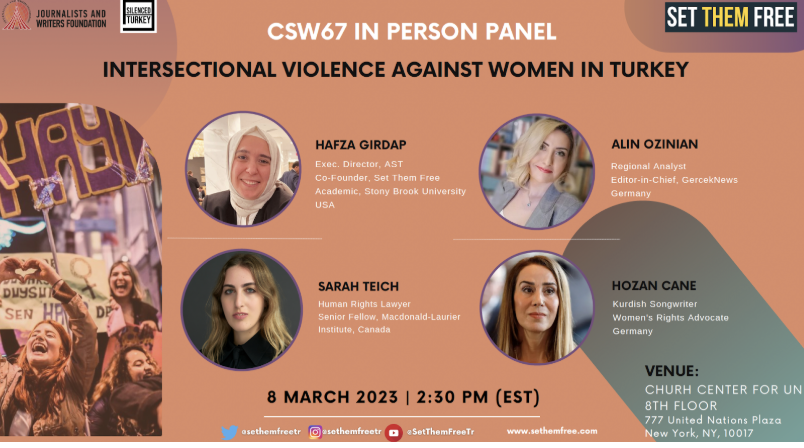
Intersectional Violence Against Women in Turkey
On the Occasion of the UN Commission on the Status of Women 67th Session
8 March 2023 | 2:30 PM | Church Center for the UN, New York
This event was a compelling and multi-faceted panel discussion centered on human rights violations, gender-based violence, and the ongoing struggles faced by women and minority groups in Turkey and the broader Middle East region. The session brought together a diverse group of speakers, including activists, journalists, survivors, and experts, who shared personal stories, analyzed systemic issues, and issued urgent calls for international solidarity and action.
The event opened with an introduction from the Co-Founder of the Set Them Free, Hafza Girdap, who spoke on this platform`s mission to promote women’s rights, girls’ empowerment, and civic education. She emphasized the importance of fostering a culture of peaceful activism that respects political, ethnic, and cultural differences, advocating for unity among diverse groups such as Kurds, Armenians, secularists, leftists, and religious minorities. She also highlighted the recent natural disasters—particularly the devastating earthquakes in Turkey and Syria—calling for ongoing civil society mobilization to provide humanitarian aid and extend solidarity to affected populations.
A significant portion of the discussion focused on gender rights, with a detailed analysis of the systemic discrimination, violence, and institutional barriers women face in Turkey. The panelists explained how the current political climate, characterized by authoritarian tendencies, increased repression, and the withdrawal from the Istanbul Convention, has worsened the situation. They described how the government’s framing of gender and sexuality issues within conservative, religious, and militaristic narratives has led to increased social and state-led violence against women and LGBTQ+ individuals. Women and sexual minorities are increasingly targeted through state sanctions, social segregation, restrictions on civil society organizations, and legal setbacks that curb their ability to advocate for their rights.
The narrative then shifted to the historical and ongoing persecution of minorities, with a focus on Armenians, Kurds, Assyrians, and Jews. Alin Ozinian, an Armenian journalist and analyst, shared her personal experiences of discrimination and violence, emphasizing that Armenians in Turkey continue to live under a cloud of denial and marginalization rooted in the legacy of the Armenian Genocide of 1915. She detailed how the Turkish state perpetuates systemic denial, refuses minority recognition, and promotes nationalistic narratives that portray Armenians as enemies of the state. Her testimony included stories of violence, massacres, and the persistent social exclusion faced by minorities, illustrating how these issues are deeply embedded in Turkey’s political and social fabric. She emphasized that minority communities are considered potential threats, often living in fear of state violence and societal hostility.
The panel also featured powerful personal stories from women who endured brutal state repression, detention, and violence. Globally acknowledged Kurdish singer Hozan Cane recounted her harrowing experience as a Kurdish woman imprisoned for nearly three years under Turkey’s counter-terrorism measures. She described the inhumane conditions of detention from lack of proper hygiene, food deprivation, threats of sexual violence to being treated as a terrorist solely based on her ethnicity and activism. She recounted the psychological trauma inflicted on her, the arbitrary nature of her detention, and her eventual release, which she described as a fragile victory amid ongoing systemic abuse.
Another personal story involved women associated with the Hizmet movement, which was criminalized after the 2016 coup attempt. Human Rights Lawyer Sarah Teich described mass arrests, torture, and unlawful detention of women affiliated with the movement. She highlighted a specific case of a mother detained while her critically ill young son was denied proper medical care, illustrating how human rights protections are ignored even in life-threatening situations. The ongoing repression of the Hizmet movement exemplifies the broader pattern of state-led violations targeting perceived political opponents and religious minorities.
The discussion extended to the brutal treatment of families abducted from abroad—specifically from Pakistan and Bahrain—who suffered physical violence, threats of sexual assault, and arbitrary detention upon their forced return to Turkey. These cases revealed a systematic pattern of illegal abduction, torture, and harassment, often accompanied by threats of sexual violence against women. Sarah Teich detailed how these violations are perpetrated under the guise of counterterrorism, with victims subjected to physical and psychological abuse, often in clandestine settings, with little hope for legal redress.
A recurring theme throughout the event was the phenomenon of femicide, exemplified poignantly by the story of a woman murdered by her ex-husband in 2010. She had filed multiple divorce cases and had sought protection from violence, but the legal system failed to prevent her death. The speaker criticized Turkey’s legal framework, noting recent legislative changes that have further marginalized women and failed to provide adequate protection against domestic violence and femicide. Sarah Teich, a human rights lawyer based in Canada, lamented that structural patriarchy, male dominance, and the persistence of misogynistic social norms continue to endanger women’s lives.
The speakers emphasized that violence against women and minorities is inherently political, rooted in systemic discrimination, social injustice, and authoritarian governance. They argued that addressing gender-based violence and minority rights violations requires not only legal reforms but also a fundamental shift in societal attitudes and international pressure. They called on international bodies—such as the UN Human Rights Council, European Court of Human Rights, and the International Criminal Court—to take more decisive actions, including passing resolutions condemning abuses, establishing evidence collection mechanisms, and opening investigations into crimes against humanity.
Despite the grim stories, the panelists offered messages of hope and resilience. They stressed that systemic violence and repression are not insurmountable obstacles and that collective action can bring about change. They urged participants to maximize the platform of the upcoming UN Commission on the Status of Women to push for justice and accountability, emphasizing the importance of solidarity beyond Turkey’s borders. The importance of civil society’s role in documenting abuses, advocating for victims, and holding perpetrators accountable was underscored as a vital part of the struggle for human rights.
The event concluded with emotionally charged personal testimonies, including the story of a woman who survived brutal domestic violence and femicide, and others recounting their imprisonment, torture, and exile. These stories underscored the pervasive nature of repression and the courage required to oppose it. The speakers collectively reaffirmed their commitment to continue advocating for justice, equality, and human rights, emphasizing that the fight against systemic violence is ongoing and that global solidarity remains essential. This CSW67 panel discussion served as a stark reminder of the ongoing human rights crises in Turkey and the Middle East, highlighting the resilience of victims and activists while calling for heightened international awareness, intervention, and sustained advocacy to end repression and ensure justice for marginalized communities.
PANELISTS:
Hafza Girdap, Executive Director of Advocates of Silenced Turkey, Co-Founder of Set Them Free – USA
Alin Ozinian, Regional Analyst, Editor-In-Chief of Gercek News – Germany
Sarah Teich, Human Rights Lawyer, Senior Fellow at the Macdonald Laurier Institute – Canada
Hozan Cane, Kurdish Songwriter, Women`s Rights Advocate – Germany
 Previous Post
 Next Post